Entry ID: GB-0006
Title: The Rains of Blood and Flesh
Alternate Names / Local Labels: Kentucky Meat Shower · Wilson County Blood Rain · Olympia Springs Flesh Fall
Location: Wilson County, Tennessee, United States · Bath County (Olympia Springs), Kentucky, United States
Date(s) of Activity: August 17, 1841 · March 3, 1876
Archive Category: Animals, Objects, Places, & Plants
Status: Documented Historical Event / Fortean Phenomenon
CONTENT NOTICE
This entry references animal remains, bodily tissue, and unsettling natural phenomena.
SUMMARY
“Rains of blood” are a recurring category of anomalous atmospheric events reported across centuries and cultures. Witnesses describe precipitation containing red fluid, tissue, or organic matter falling from otherwise clear skies.
Two of the most famous American examples occurred in the nineteenth century in the neighboring states of Tennessee and Kentucky.
The first incident took place on August 17, 1841 on a tobacco farm in Wilson County, Tennessee. Witnesses reported a brief shower of blood-like fluid accompanied by fragments of tissue and fat that fell across approximately six hundred yards of cultivated fields.
The second event occurred on March 3, 1876 near Olympia Springs in Bath County, Kentucky. During this incident, chunks of red meat ranging from one to four inches in size reportedly fell from the sky over an area roughly one hundred yards across.
Both events produced intense speculation at the time. Religious interpretations framed the incidents as divine warnings or supernatural signs. Scientists and physicians attempted to produce rational explanations involving wind transport, decomposing carcasses, or carrion birds.
Despite investigation, neither event was conclusively explained.
Today the phenomenon is frequently categorized as a Fortean event…an occurrence documented historically but resistant to conventional explanation.
VERIFIED FACTS
Wilson County, Tennessee — August 17, 1841
• A shower of blood-like fluid and animal tissue reportedly fell over farmland near Lebanon.
• The event occurred shortly after noon on what witnesses described as a clear day.
• The material included congealed blood, fat, and small pieces of decomposing flesh scattered across tobacco leaves.
• Dr. Gerard Troost, professor at the University of Nashville and Tennessee State Geologist, analyzed samples and concluded the material was terrestrial animal matter.
• Troost proposed that a desiccated animal carcass had been carried by strong atmospheric winds before falling from a cloud formation.
• Later reporting in the American Journal of Science suggested the incident may have been a hoax involving scattered hog remains, though this explanation relied largely on newspaper testimony rather than direct evidence.
Bath County, Kentucky — March 3, 1876
• Mrs. Mary Crouch reported witnessing meat fall from the sky while working on her porch.
• The fall lasted approximately one to two minutes.
• Multiple witnesses reported clear weather with only light wind.
• Samples collected from the ground were examined by scientists.
• Dr. Allan McLane Hamilton suggested the material resembled lung tissue from either a horse or a human infant due to similarities in structure.
• Other samples were identified as muscle tissue and cartilage.
• One widely accepted theory proposed that vultures regurgitated carrion while flying overhead.
None of these explanations fully accounts for the volume, distribution, or timing described by witnesses.
OPERATIONAL CONTEXT
Events involving unusual material falling from the sky have been recorded globally for centuries. These include reports of:
• red-colored rain interpreted historically as blood
• showers of fish, frogs, or other small animals
• dust storms depositing colored particles over wide regions
In many cases, meteorological explanations such as atmospheric transport or biological dispersal have eventually been identified.
However, the Wilson County and Bath County events remain unusual because the material involved identifiable animal tissue rather than sand, spores, or small animals.
The rarity and disturbing nature of the phenomenon ensured that both incidents became enduring regional legends.
ANOMALOUS NOTES
Several aspects of the two events remain difficult to reconcile with conventional explanations.
Weather Conditions
Witnesses in both locations reported clear skies or minimal wind at the time of the fall.
Distribution Pattern
The material fell over relatively confined but consistent areas rather than appearing randomly scattered.
Biological Composition
Laboratory analysis identified real organic tissue rather than plant matter or mineral deposits.
Bird Behavior
The vulture-regurgitation explanation remains popular but imperfect. While vultures can vomit to escape predators, they typically do so individually and near the ground, not simultaneously across a wide area.
Hoax Claims
The Wilson County event was later described in some newspapers as a prank involving scattered hog remains. However, this claim appears to have emerged after the fact and lacks direct documentation.
Because of these unresolved contradictions, the events are frequently cited in Fortean literature.
HUMAN FACTOR
Individuals associated with the historical accounts include:
• Dr. Gerard Troost: geologist and medical investigator of the Tennessee event
• Mrs. Mary Crouch: primary eyewitness to the Kentucky incident
• Dr. Allan McLane Hamilton: physician who analyzed tissue samples
• Charles Fort: early twentieth-century researcher who catalogued the events in The Book of the Damned
Fort used the cases as examples of what he believed to be the scientific establishment’s tendency to dismiss unexplained phenomena by forcing them into conventional frameworks.
CULTURAL / MATERIAL ARTIFACTS
The Kentucky “meat shower” has become one of the most famous examples of Fortean phenomena in North America.
The event appears in:
• Fortean research literature
• folklore collections
• discussions of unexplained atmospheric events
• paranormal and cryptozoological studies
The story persists largely because it sits at the intersection of documented history and unresolved mystery.
RESEARCH EXPERIMENTS
(Modern Investigative Work)
Due to the historical distance of the events, modern research has relied on indirect investigative methods including archival study, astrology, and remote-viewing experiments.
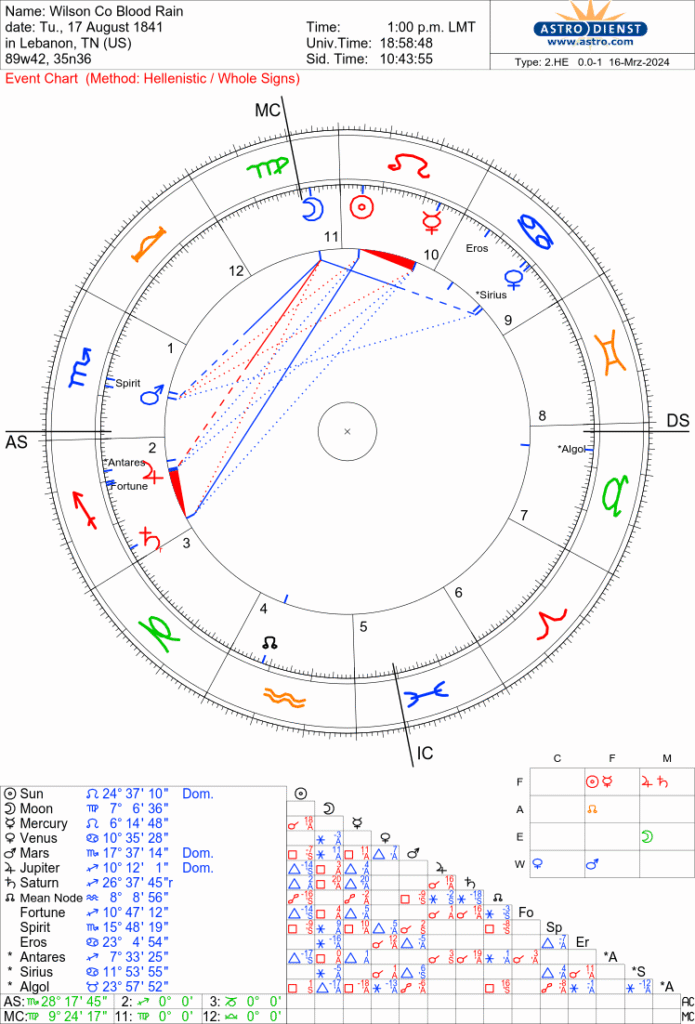
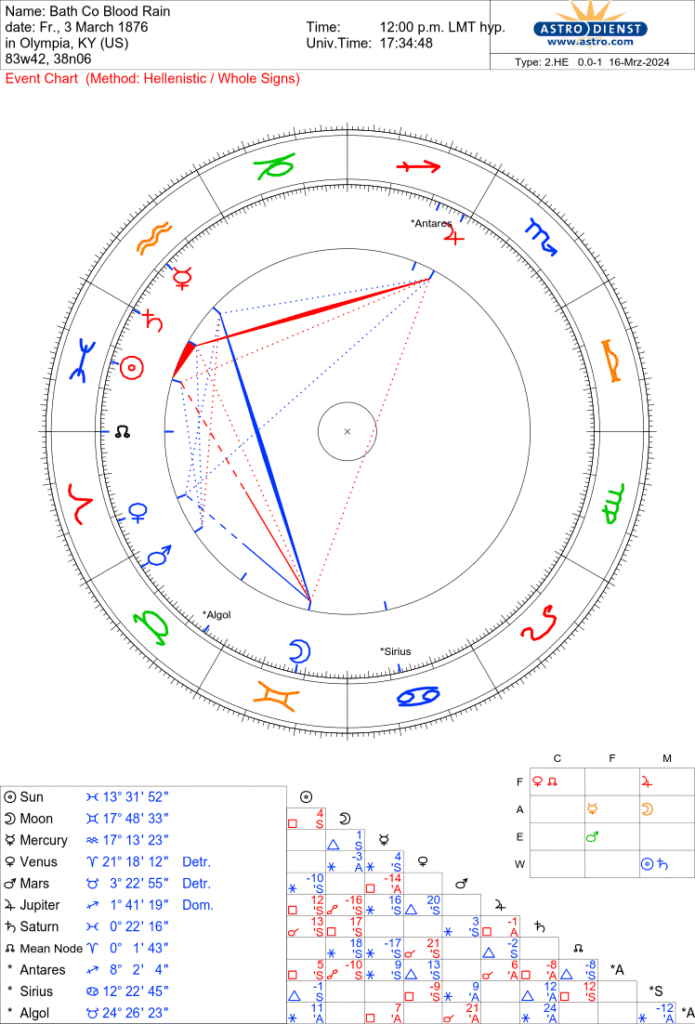
Astrological Comparison
A comparative chart analysis of the two dates revealed an unusual shared pattern.
Both events occurred during configurations involving tense “square” aspects between major planetary bodies.
Saturn appeared prominently in both charts, representing boundaries, pressure, and confrontation with reality or authority.
In the Bath County event, Saturn formed a square with the Sun within the twelfth house of Pisces, a region astrologically associated with hidden forces, dreams, and the subconscious.
In the Wilson County event, Saturn formed a square with Jupiter in the first house of Sagittarius, indicating visible, outward conflict or dramatic manifestation.
Another square between the Sun and Mercury suggested confusion, conflicting explanations, and information overload…consistent with the many competing theories proposed at the time.
These interpretations remain speculative but suggest symbolic patterns of tension and disruption.
Remote Viewing Session — Wilson County Event
Dex’s research partner, Damon, conducted a remote-viewing session using the Ganzfeld Sensory Method, attempting to perceive conditions surrounding the Wilson County incident.
Reported impressions included:
• extreme heat on the day of the event
• a distortion or refraction of light high in the sky
• the sensation of something moving overhead but not clearly visible
• a moment when organic material began falling from that unseen source
When the viewer attempted to focus more closely on the object or phenomenon, the session reportedly produced a strong sensation of being pushed away or falling.
The session ended abruptly around the fifteen-minute mark.
Interpretation of these impressions remains open. If taken literally, the description suggests the presence of a large airborne object or phenomenon not readily visible to observers on the ground.
THE CREATURE CLAIM
(Operational Claim Variant: Atmospheric Source)
If a future incident resembling the Kentucky or Tennessee events were observed, relevant indicators might include:
• precipitation containing organic tissue
• absence of nearby storms or strong winds
• reports of atmospheric distortions or visual anomalies
• biological samples from multiple species
• sudden appearance of falling material without visible origin
Because such events are extremely rare, no modern protocol exists for systematic investigation.
ARCHIVAL INTERPRETATION
The Rains of Blood represent a classic intersection of folklore, early science, and human anxiety about unexplained natural phenomena.
Whether the cause lies in misunderstood animal behavior, rare meteorological processes, deliberate hoaxes, or something more unusual, the events demonstrate how communities respond when the ordinary rules of nature appear to break.
In this way the phenomenon functions not only as a mystery but also as a mirror.
It reflects our discomfort with the unknown…and the stories we construct to make that discomfort bearable.
BIBLIOGRAPHY / SOURCE NOTES
Historical accounts from nineteenth-century newspapers and scientific publications.
Charles Fort, The Book of the Damned.
Regional reports from Wilson County, Tennessee and Bath County, Kentucky.
BREADCRUMBS
The archive invites further investigation into the following questions:
• Could atmospheric vortices transport decomposing biological material over long distances?
• Were vultures or other carrion birds present in unusual numbers during the Kentucky incident?
• Are there meteorological records suggesting rare wind patterns during the Tennessee event?
• Could unidentified aerial phenomena explain the atmospheric distortion reported in the remote-viewing experiment?
• Why do “rains of blood” appear repeatedly in historical records across multiple continents?
Readers, researchers, and witnesses are encouraged to submit documentation or analysis related to similar events.
Archival Status: Filed
Last Updated: 03/16/2026
Archivist Initials: EH